
D-Mannose for UTI
If you’ve searched for a natural way to deal with urinary tract infections (UTIs), you’ve probably come across D-mannose. It’s one of the most discussed supplements for bladder health. But does the research back up its benefits? The answer depends on what you’re using it for. Here’s what the evidence actually shows about D-mannose for UTI prevention and relief.
What Is D-Mannose?
D-mannose is a simple sugar closely related to glucose. It occurs naturally in some fruits and vegetables. The body absorbs most of it in the upper digestive tract, then passes it out through the urine, largely unchanged.
Because it travels through the urinary tract on its way out, researchers have long been curious about its role in urinary health.
How Does D-Mannose Work for UTIs?
Most UTIs are caused by a bacterium called E. coli. This bacterium uses tiny, finger-like structures on its surface to grab onto the lining of the bladder. Once it attaches, it multiplies, and the infection takes hold.
Blocking Bacteria From Sticking to the Bladder Wall
D-mannose is thought to work by competing for the same attachment points these bacteria use. In lab studies, it binds to the receptors E. coli would otherwise use to cling to bladder cells. If enough D-mannose is present, bacteria attach to it instead and get flushed out in the urine before an infection can take hold.
The mechanism is well demonstrated in the lab, though researchers note that there is a need for more studies.
What Does the Research Say?
The research on D-mannose for UTIs is mixed, and it helps to understand why.
Some smaller trials report encouraging results. One randomized trial found that women taking daily D-mannose had a lower rate of repeat infection than women using no preventive treatment at all, with results similar to a common antibiotic. A separate analysis of women treated for an active UTI found that D-mannose led to symptom improvement and cure rates comparable to antibiotics.
However, a 2022 review of the overall evidence found that current research isn’t strong enough to confirm whether D-mannose prevents or treats UTIs. In short, the findings are inconsistent, and more high-quality research is needed.
Dosage, Safety, and Talking to Your Doctor
There’s no official, regulator-approved dosage for D-mannose, since it’s sold as a supplement rather than a medication. Across the studies reviewed, daily amounts commonly ranged from about 1 to 2 grams, sometimes split into more than one dose and dissolved in water.
D-mannose is generally well tolerated. The most common side effects are mild digestive symptoms, such as loose stools or bloating. Because it’s a sugar, people with diabetes should talk with a healthcare provider before use, and safety during pregnancy and breastfeeding hasn’t been well studied.
If you’re taking antibiotics for a UTI, or considering D-mannose alongside other treatments, speak with your doctor or pharmacist first. This is especially important if your symptoms are severe, you have a fever, or your infection doesn’t improve within a couple of days.
A Structured, Natural Approach to Urinary Health
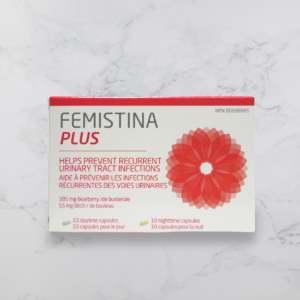
D-mannose is often combined with other ingredients designed to support the urinary tract around the clock. Femistina Plus, for example, is a Health Canada-licensed natural health product built on exactly that idea: a day-and-night capsule system. The night capsule contains D-mannose, while the day capsule includes botanical ingredients traditionally used for urinary support.
Femistina Plus supports urinary tract health and helps reduce the recurrence of UTIs as part of a structured, natural approach, not as a replacement for antibiotics when they’re medically necessary.
The Bottom Line on D-Mannose for UTI
While smaller studies suggest d-mannose may ease symptoms or reduce repeat infections, larger trials found no clear prevention benefits. If you’re dealing with frequent or severe UTIs, talk with your healthcare provider about Femistina Plus, which combines d-mannose with arbutin, birch, berberine and forskolin to prevent recurrent UTIs at every stage of infection.
References
PMC: Why d-Mannose May Be as Efficient as Antibiotics in the Treatment of Acute Uncomplicated Lower Urinary Tract Infections—Preliminary Considerations and Conclusions from a Non-Interventional Study
Healthline: D-Mannose for UTI: Dosage, Treatment, Side Effects, and More
JAMA Internal Medicine: d-Mannose for Prevention of Recurrent Urinary Tract Infection Among Women: A Randomized Clinical Trial
Live UTI Free: D-Mannose for UTI: Dosage, Benefits, Side Effects
NIHR Evidence: D-Mannose Does Not Prevent Urinary Tract Infections (UTIs)